
Series: AI in the Real World: Episode 1 By Darren Redmond | darrenredmond.com
Who Is This Guy?
Before we get into the LEGO labels and pricing, it’s worth knowing who’s writing this, because the context matters.
I’m Darren Redmond, an AI consultant with over 30 years of experience in technology, data science, AI, and software engineering. I’ve worked across some of the most demanding sectors in tech: SaaS, Airlines, E-commerce, content creation, and Fintech. I’ve run large engineering teams, and organisations for Nasdaq companies. I have delivered courses in AI and programming to MBA, computer science, & business school students at one of the most prestigious universities in the world. Today I help companies, from startups to enterprise, develop and execute their AI strategy, and I work hands-on as an AI engineer building the systems that make those strategies real.
Here’s the thing: most of what I do professionally, I can’t talk about publicly. NDAs are the price of working at the frontier. When you’re building intelligent systems for a Fintech platform, or helping a major airline rethink how AI handles operations, you sign agreements that prevent you from saying exactly what you built, for whom, and what it changed.
So I tell parables.
I take the shape of the problems I solve for large companies, the data challenges, the automation opportunities, the places where AI creates genuine leverage, and I translate them into language anyone can understand. Sometimes that’s a blog post about a small business. Sometimes it’s a YouTube video about content creation. And sometimes, it’s a LEGO museum in Ireland called Redmond’s Forge.
Redmond’s Forge isn’t just a hobby. It’s a living demonstration of what AI can do in the real world, told in the language of bricks.
Every label generator, every pricing analysis, every video, blog post, every automated data pipeline I build for the Forge is a parable. The underlying patterns, data ingestion, market analysis, automated reporting, intelligent pricing, are the same ones that run inside the companies I advise. The difference is that you can hold a LEGO label in your hand and immediately understand what the AI did and why it matters.
That’s the point of this series.
The Problem
Like I said, I own a museum called Redmond’s Forge. It’s a LEGO museum, part display, part retail, part obsession made physical. We’ve got sets spanning decades: retired classics, current releases, sealed collector pieces, mini-figures, and everything in between.
And for a long time, imagining how to manage and execute the retail side of it was a pain. So much so, I didn’t engage in it.
Price labels printed on regular paper. Handwritten set numbers. A spreadsheet I kept half-updated. The kind of organised chaos that works right up until it doesn’t, until a customer asks you the price of something and you have to go hunting.
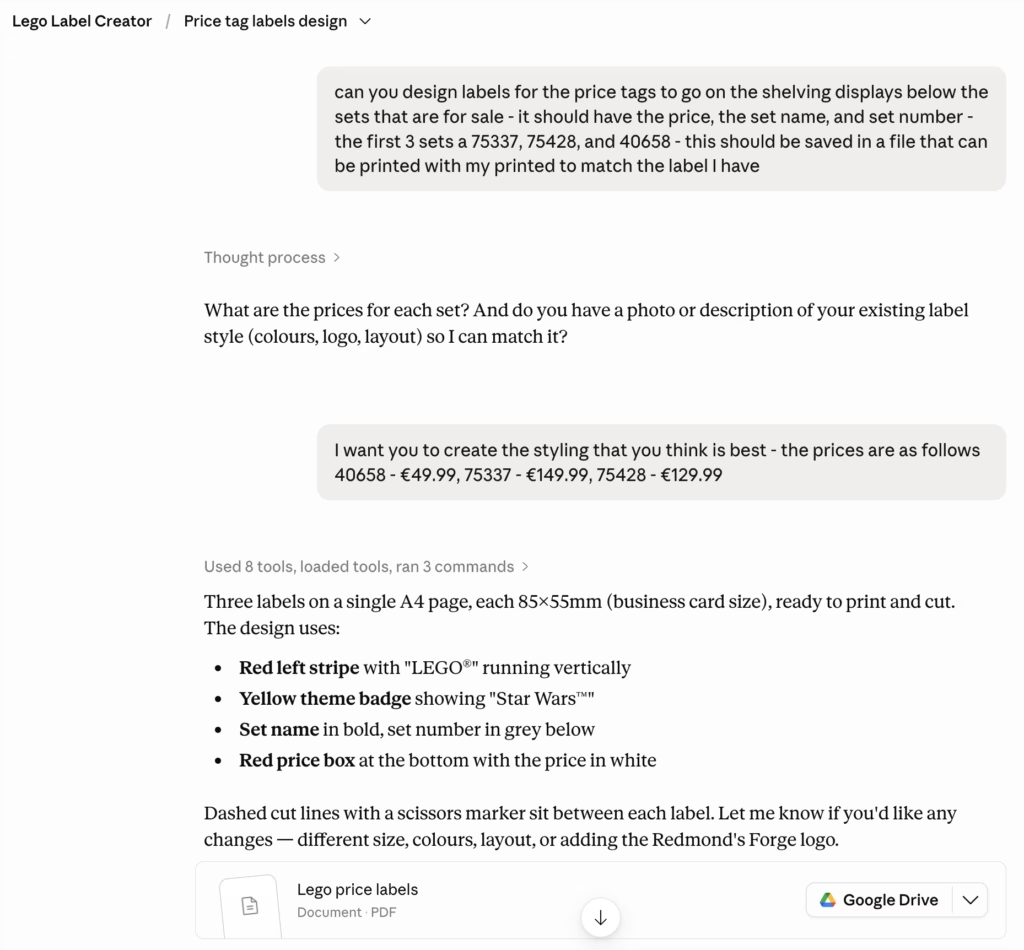
So I decided to fix it. And instead of doing it the old way, I decided to do it with AI. Specifically, with Claude CoWork from Anthropic.
What followed was one of the most genuinely useful experiences I’ve had with AI, (this week), not generating text or answering trivia questions, but actually building something real that I use every day. This is the story of what we built, how we built it, and what it taught me about the practical power of AI when you apply it to a real problem, and all without any code.
What We Built
Over a two hour session with Claude Code, we built a complete label and pricing system from scratch. Here’s what it does:
1. A Professional Label Generator
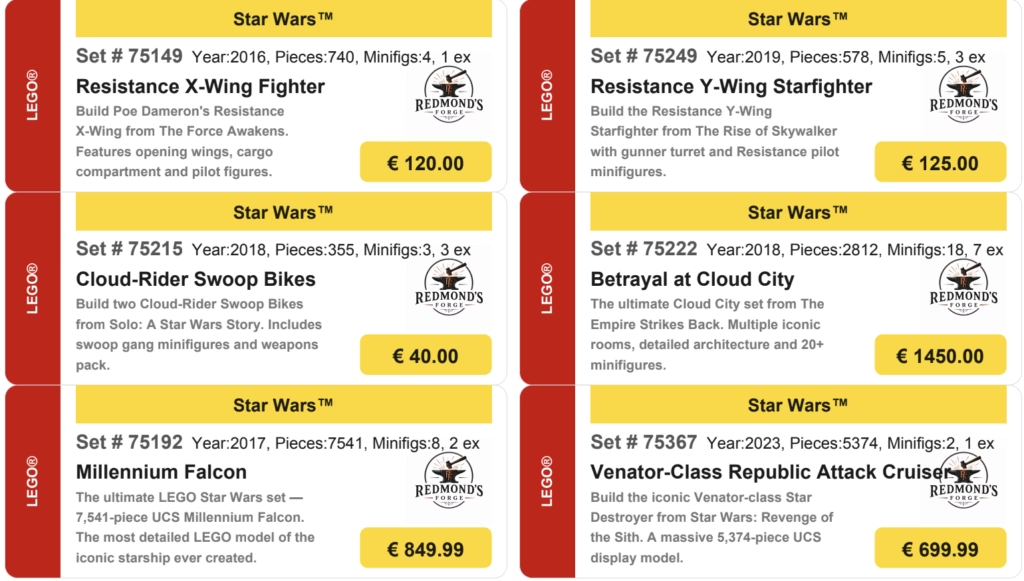
Unbeknownst to me, we wrote a Python script using a library called ReportLab that generates A4 PDF sheets of price labels, 14 per page, formatted precisely to the Avery L7163 standard used by label printers. Each label includes:
- The set name and number
- A colour-coded theme badge (Star Wars gets gold, Harry Potter gets purple, City gets blue…)
- The Redmond’s Forge logo
- The price, prominently displayed
- A short AI generated description of the set
- The forgotten informative pieces (year, piece count, minifigure count – but more on this later)
This wasn’t just asking AI to write code. It was a back-and-forth process, describing what I needed, seeing the output, refining it, catching errors, adding features. Claude CoWork held the context of what we were building across the whole conversation and made intelligent suggestions I hadn’t thought of.
2. A Set Database of 3912 LEGO Sets
Claude helped me build and populate a database of 3912 LEGO sets, with names, themes, EUR retail prices, year, piece count, minifigure count, include exclusives, and an AI generated descriptions for every single one. This involved Claude researching sets on Brickset, cross-referencing prices, and writing natural-language descriptions that actually sound good on a label.
When I had a batch of 138 new sets to add, Claude ran two parallel research agents simultaneously to look them all up at once. 138 sets. There were four parallel agents when I got cocky and wanted to add over 500 sets, (don’t get cocky kid, as Han once said to Luke). And all in one session.

3. Theme Section Signs
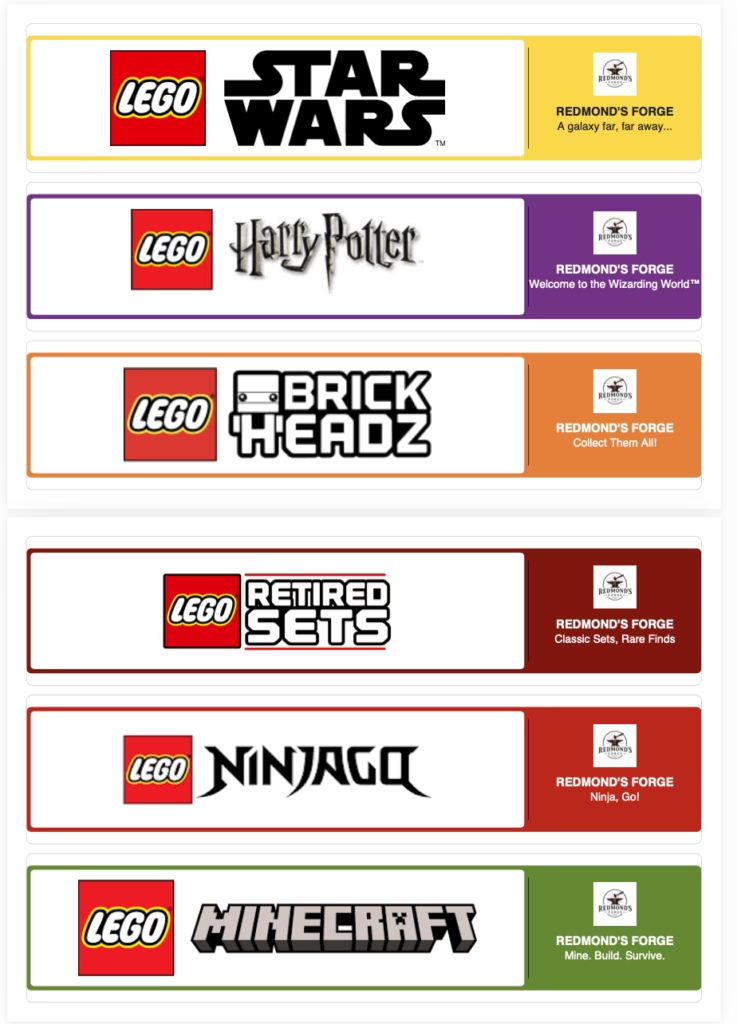
Alongside the price labels, we generated A4 landscape display signs for each theme section, Star Wars, Harry Potter, BrickHeadz, Ninjago, Minecraft, and a “Retired Sets” section. Each sign has a theme logo, the Redmond’s Forge branding, and a consistent professional layout.
4. Sealed Market Valuation Analysis
This is where it got really interesting.
I had the price spreadsheet generated with the original RRP (retail price), 3912 rows, with columns for RRP, sealed low/mid/high market prices sourced from eBay, BrickLink, and comparable sales. Claude read the entire spreadsheet, compared every set’s current sale price against its sealed mid-market value, and produced a full analysis report.
The findings were striking:
- 70% of the collection (2738 out of 3912 sets) has a sealed mid-market value above the current sale price
- The collection carries a net sealed premium of €9,234 across all sets
- The single biggest opportunity: the Imperial Shuttle (#10212), which I was selling for €249.99. Its sealed mid-market value? €1,415.00
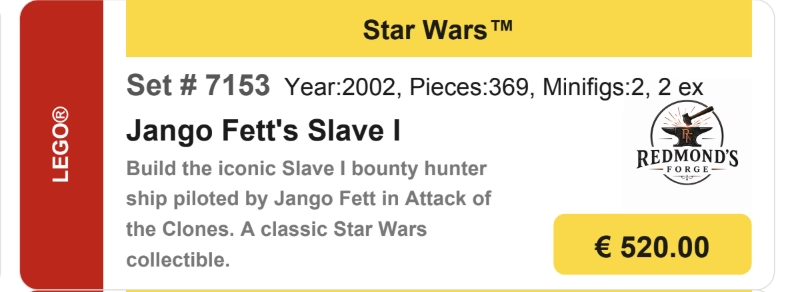
- Jango Fett’s Slave I (#7153): on sale at €49.99, sealed mid at €520.00, a 940% premium
- Several large UCS sets (AT-AT, Millennium Falcon, Razor Crest) were actually overpriced relative to where the sealed market has moved
After the analysis, and my conversation with Claude, it updated all 2738 prices automatically, directly in the Python script, which then regenerated the PDF, CSV, JSON, and Markdown outputs with the new pricing that I can make available across multiple platforms including linking to my POS system on Revolut, more on this in a subsequent blog post.
5. Collector Intelligence on Every Label
Once the pricing was right, we went deeper into the data. Every serious LEGO collector knows that three numbers matter above everything else: the year a set was released, how many pieces it contains, and how many minifigures it includes, particularly ones that are exclusive to that set and can’t be found anywhere else.
These aren’t just interesting facts. They’re value signals. A 2002 set with 369 pieces and 2 exclusive minifigures tells a very different story to a 2024 set with 297 pieces and no exclusives. The year signals rarity. The piece count signals build value. The exclusive minifig count often explains the sealed premium more than any other single factor, e.g. the Cloud City Boba Fett.
So we added all of it. Claude ran four parallel research agents, simultaneously looking up year, piece count, total minifigure count, and exclusive minifigure count for all 3912 sets at once. The data went directly into the database, and every label was updated automatically.
The labels now show a compact info line directly alongside the set number:
Set # 75222 Year:2018, Pieces:2812, Minifigs:18, 7 ex
For Betrayal at Cloud City, one of the most sought-after Star Wars sets ever made, that single line tells a collector everything they need to know before they even read the description. 2018 means retired. 2,812 pieces means substantial build. 18 minifigures, 7 of them exclusive, means the secondary market will always be strong.
That’s the kind of information that used to live in a collector’s head. Now it’s on the label, for every single set, generated and formatted automatically by AI.
The Parable This Tells
Here’s what I want you to think about as you read this.
Everything I’ve just described, data ingestion, parallel research agents, market analysis, automated price updates, multi-field database enrichment, formatted output generation, low-code no-code, these are the same building blocks that power serious AI systems inside large organisations.
When a Fintech company wants to automatically enrich a financial instrument database with market data, they use the same pattern I used to add piece counts to 3912 LEGO sets. When an airline wants to pull in weather data, or when an E-commerce company wants pricing against a live market and flag anomalies, it’s the same logic I used to find €9,234 in underpriced sealed sets. When an E-commerce platform wants to automatically generate consistent, structured product descriptions at scale, it’s the same approach I used to write 3912 LEGO set descriptions.
The problems are bigger. The stakes are higher. The data is more complex. But the shape of the solution is identical.
LEGO is just a language I can speak publicly.
What This Actually Felt Like
I want to be honest about something: this wasn’t magic. It required me to know what I wanted, to describe it clearly, to catch mistakes (there were some duplicates, some set numbers that needed decoding, some prices that needed clarifying), and to stay engaged throughout. But in all walks of business data needs to be cleansed.
But the difference was speed and capability. What would have taken me months of manual work, researching 3912 sets, writing 3912 descriptions, formatting 3912 labels, doing a market analysis, updating prices, enriching every record with collector data, happened over the span of 2 hours.
And the quality was genuinely good. The labels look professional. The analysis was insightful. The solution works.
Why LEGO?
LEGO is actually a perfect domain for demonstrating AI’s practical value. It has:
- Rich, structured data: every set has a number, name, theme, piece count, RRP, release year, minifigure count
- A deep secondary market: with real pricing dynamics (sealed premiums, retirement effects, rarity)
- Community knowledge: decades of collector data on BrickLink, Brickset, eBay
- Tangible output: you can hold the labels, put up the signs, see the PDFs
When AI touches LEGO data, you can see the results in the physical world. That’s what makes it such a great test case, and such a useful parable.
What’s Next
This is Episode 1 of an ongoing series. In future episodes, we’ll be exploring:
- Claude Code, skills, code coverage, architecture reviews, cyber reviews
- AI Risk Registry and the EU AI acts impact on a LEGO museum, solutions, consultancy
- Using AI to identify which LEGO sets are worth buying at retail to flip sealed, which to build and display, and which to keep sealed in the museum
- Building an automated price tracker that monitors BrickLink and flags opportunities
- Using AI image recognition to catalogue minifigures
- Creating a public-facing inventory system for Redmond’s Forge visitors
- Integrating with Revolut’s POS system.
Each one is a real problem I’m solving for the Forge. And each one is a parable for something bigger.
If you want to follow along, subscribe at https://www.darrenredmond.com, follow me on YouTube at @darrenredmond, and find me on TikTok and Instagram.
And if you want to know more about the LEGO museum in Ireland checkout https://www.redmondsforge.com and @redmondsforge on YouTube, TikTok, Instagram, and everywhere else.
The Takeaway
AI doesn’t replace expertise. I needed to know about LEGO, about pricing, about what makes a good label, about what collectors actually care about, to get useful output. But AI dramatically amplifies what one person can build and how quickly they can build it.
For anyone running a small business, a collection, a museum, a hobby project, or you are a large multi-national, the question isn’t whether AI can help. It’s whether you’re willing to sit down and describe your problem clearly enough to let it.
I did. And Redmond’s Forge is better for it.
The same will be true for your business, irrespective of the size. That’s the point of this whole series.
Darren Redmond is an AI consultant and software engineer with over 30 years of experience, working with companies in SaaS, Airlines, E-commerce, content creation, and Fintech on AI strategy and engineering. He runs Redmond’s Forge, a LEGO museum and retail space in Ireland, and uses it as a living demonstration of AI applied to real-world problems. Follow the AI in the Real World series at darrenredmond.com.


No responses yet